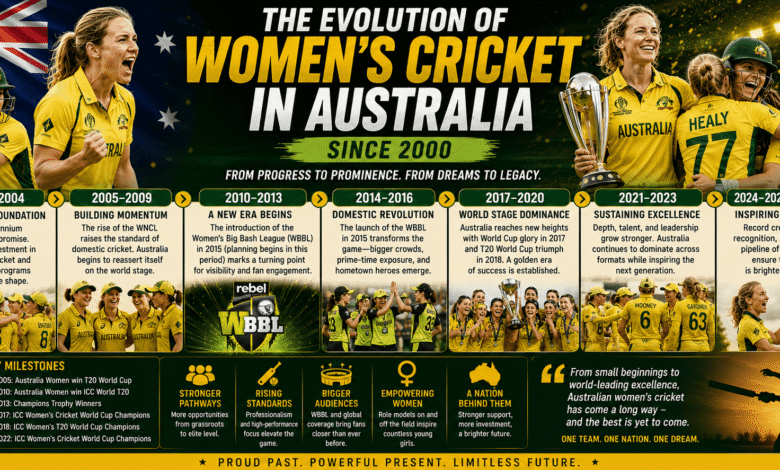
At the turn of the millennium, Australia was already one of the strongest teams in women’s cricket. Yet, the game itself remained largely amateur, attracting limited media attention, modest crowds, and relatively few professional opportunities. Fast forward to today, and Australia has become the benchmark for excellence in the women’s game, producing world-class players, setting attendance records, and winning major international trophies with remarkable consistency.
The transformation has not been accidental. It is the result of sustained investment by Cricket Australia, a strong domestic structure, professional contracts, and a steady pipeline of elite talent. Since 2000, Australian women’s cricket has evolved from a successful national side into one of the most dominant sporting programs in the world.
Australia Women’s Cricket at the Start of the 21st Century
When the 2000s began, women’s cricket was still in the early stages of professional development. Most Australian players balanced international cricket with full-time jobs or studies, and financial support was limited.
Despite these challenges, Australia possessed a talented core led by players such as Belinda Clark, Cathryn Fitzpatrick, Karen Rolton, and Lisa Keightley. Their performances laid the foundation for future generations and established Australia as a leading force in international women’s cricket.
A landmark moment came in 2000, when Australia defeated New Zealand in the final at Lincoln to win the ICC Women’s Cricket World Cup, reaffirming their status as one of the world’s premier teams.
Building a Strong Domestic Structure
One of the biggest reasons for Australia’s sustained success has been its domestic cricket system.
For many years, the Women’s National Cricket League (WNCL) served as the country’s premier 50-over competition, giving emerging players high-quality competitive cricket. The WNCL became a crucial pathway from state cricket to the national team.
A major breakthrough came in 2015 with the launch of the Women’s Big Bash League (WBBL). Modeled on the successful men’s Big Bash League, the WBBL brought together Australian stars and leading international players in a fully televised T20 competition.
The league quickly became one of the strongest domestic women’s tournaments in the world. Young Australian players gained regular exposure to elite competition, while experienced internationals raised the overall standard of play.
The WBBL has since produced numerous Australian internationals, including players who have gone on to excel in ICC tournaments.
The Move Towards Professionalism
Perhaps the most significant development since 2000 has been the professionalization of women’s cricket.
In the early 2000s, central contracts existed but provided limited financial security. Over time, Cricket Australia steadily increased investment in the women’s game.
Key milestones included:
| Year | Development |
| 2000 | Australia won the Women’s Cricket World Cup |
| 2005 | Expanded central contracts and increased support for elite players |
| 2015 | Launch of the Women’s Big Bash League |
| 2017 | Landmark pay agreement significantly increased player earnings |
| 2022 | Equal prize money introduced for men’s and women’s domestic competitions by Cricket Australia |
| 2023 | Continued expansion of professional pathways and grassroots investment |
The 2017 Memorandum of Understanding (MOU) between Cricket Australia and the Australian Cricketers’ Association marked a turning point. It substantially improved player salaries and benefits, allowing many cricketers to pursue the sport full-time.
Australia subsequently became one of the first countries where women’s cricket offered a genuine professional career.
A Golden Generation of Players
Australia’s dominance has been driven by an extraordinary succession of players across multiple generations.
The Pioneers of the 2000s
Players such as Belinda Clark, Karen Rolton, Cathryn Fitzpatrick, and Lisa Sthalekar carried Australia through the early part of the century. They combined experience, tactical awareness, and consistency to keep the team among the world’s best.
Karen Rolton, in particular, is remembered as one of the finest batters in women’s cricket history, while Cathryn Fitzpatrick remains one of the fastest bowlers the women’s game has produced.
The Modern Era
As the sport became increasingly professional, a new generation emerged.
Players including:
- Meg Lanning
- Ellyse Perry
- Alyssa Healy
- Beth Mooney
- Jess Jonassen
- Ashleigh Gardner
- Megan Schutt
- Annabel Sutherland
- Tahlia McGrath
have collectively maintained Australia’s position at the top of world cricket.
These cricketers have not only excelled internationally but have also become global stars through competitions such as the WBBL, the Women’s Premier League (WPL), and England’s domestic leagues.
Australia’s Success at ICC Tournaments
No team has matched Australia’s consistency in major ICC events over the past two decades.
ICC Women’s Cricket World Cup
Australia won the Women’s ODI World Cup in:
- 2005
- 2013
- 2022
The team also reached multiple other finals during this period, demonstrating remarkable consistency in the 50-over format.
ICC Women’s T20 World Cup
Australia claimed T20 World Cup titles in:
- 2010
- 2012
- 2014
- 2018
- 2020
- 2023
Their six titles are the most by any nation in the tournament’s history.
One of the defining moments came in 2020, when Australia defeated India by 85 runs at the Melbourne Cricket Ground in front of 86,174 spectators—the highest attendance for a standalone women’s sporting event in Australia at the time and one of the largest crowds ever recorded for a women’s cricket match.
Australia’s ICC Tournament Success Since 2000
| Tournament | Titles Since 2000 |
| Women’s ODI World Cup | 4 (2000, 2005, 2013, 2022) |
| Women’s T20 World Cup | 6 (2010, 2012, 2014, 2018, 2020, 2023) |
| Commonwealth Games | Gold Medal (2022) |
The Impact of Cricket Australia
Cricket Australia’s long-term planning has been central to the game’s growth.
Key initiatives have included:
- Investing in junior girls’ cricket.
- Expanding school participation programs.
- Increasing media coverage and broadcast accessibility.
- Enhancing coaching and sports science support.
- Strengthening talent identification pathways across states.
These efforts have created one of the most sustainable talent pipelines in world cricket.
The Rise of Women’s Franchise Cricket
Australian players have also benefited from the rapid expansion of franchise leagues.
Competitions such as:
- Women’s Big Bash League (Australia)
- Women’s Premier League (India)
- The Hundred (England)
have exposed players to different playing conditions, international teammates, and high-pressure environments.
Australian cricketers have consistently been among the most sought-after overseas signings, reflecting the strength of the country’s development system.
Challenges Ahead
Despite Australia’s remarkable success, new challenges continue to emerge.
Competition from India, England, South Africa, New Zealand, and other improving nations has become increasingly intense. Managing player workloads across international cricket and multiple franchise leagues is another growing concern.
There is also an ongoing focus on expanding participation among diverse communities and ensuring that regional pathways remain strong to sustain the country’s talent pipeline.
Conclusion
The evolution of women’s cricket in Australia since 2000 is one of the sport’s greatest success stories. What began as a talented but largely semi-professional team has grown into a fully professional program admired around the world.
Through visionary administration, investment in domestic cricket, world-class coaching, and an extraordinary succession of elite players, Australia has set the standard for excellence in the women’s game. Their record-breaking achievements, sustained dominance in ICC tournaments, and influence on the global growth of women’s cricket ensure that Australia’s impact extends far beyond trophies.
As women’s cricket continues to expand worldwide, Australia’s journey over the past quarter-century serves as a model for how long-term planning, professional opportunities, and grassroots development can transform a sport.
Also Read: Royal Challengers Bengaluru Women’s Squad and WPL History