
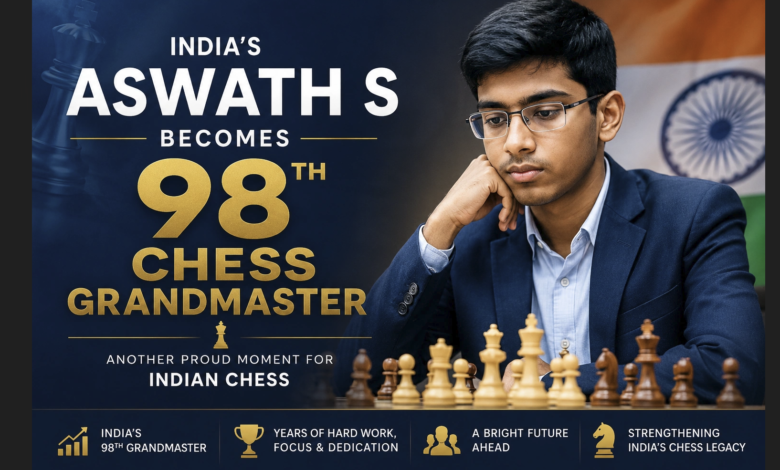
Indian chess has celebrated yet another landmark achievement. Aswath S has officially become India’s 98th Chess Grandmaster, adding his name to a rapidly growing list of elite players who continue to strengthen the country’s reputation as a global chess powerhouse.
Only a few decades ago, India had just one grandmaster—Viswanathan Anand. Today, the nation is producing elite players at an astonishing pace, with teenagers and young professionals regularly achieving the highest title awarded by FIDE. Aswath S’s success is another sign that India’s chess pipeline remains stronger than ever.
Quick Summary
- Aswath S has become India’s 98th Chess Grandmaster.
- The Grandmaster (GM) title is the highest lifetime title awarded by FIDE.
- His achievement reflects India’s remarkable depth of young chess talent.
- India continues to be one of the fastest-growing chess nations in the world.
- Young Indian players are consistently succeeding in international tournaments.
Who Is Aswath S?
Aswath S is one of India’s brightest emerging chess talents. Over the past several years, he has steadily progressed through national and international tournaments, earning the experience and rating required to compete against elite opposition.
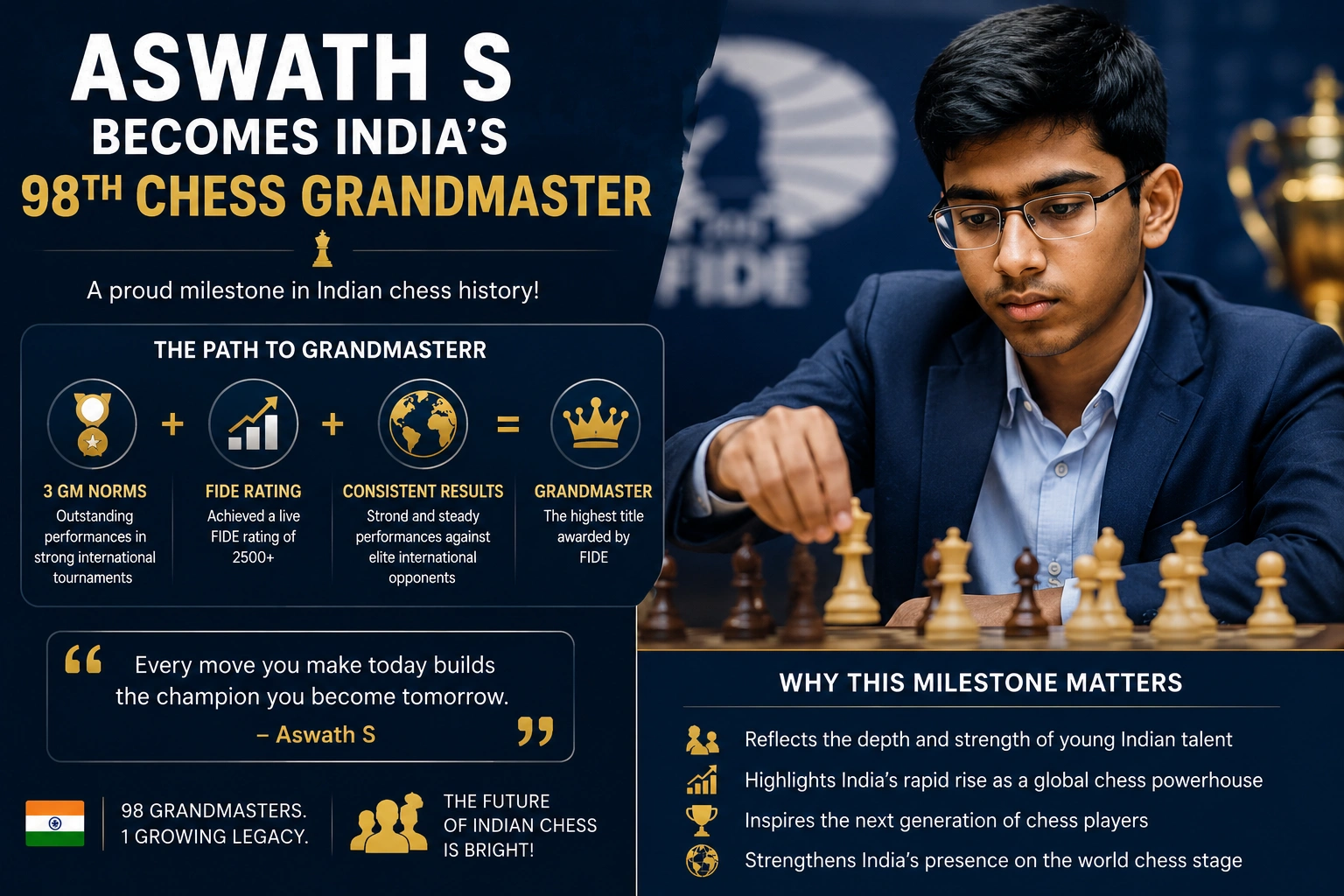
Like every Grandmaster, Aswath had to complete three demanding GM norms while also crossing the required FIDE rating threshold of 2500 at some point in his career. Achieving both milestones requires consistent performances against internationally rated opponents, making the title one of the most difficult accomplishments in professional chess.
His promotion to Grandmaster is the result of years of disciplined preparation, tournament experience, and steady improvement rather than one standout event.
How Did Aswath S Earn the Grandmaster Title?
Becoming a Grandmaster is never a matter of a single tournament. Players must perform consistently over several years while meeting strict FIDE requirements.
To earn the title, Aswath successfully completed:
Three Grandmaster Norms
A GM norm is awarded for an outstanding performance in a qualifying international tournament featuring strong titled players from multiple countries.
Required FIDE Rating
Every Grandmaster must achieve a live FIDE rating of at least 2500 during their career, even if that rating is reached only once.
Consistent International Results
Strong performances against experienced international opponents helped Aswath meet the final requirements needed for FIDE’s approval.
These achievements highlight both technical skill and remarkable consistency under pressure.
Why India’s 98th Grandmaster Is a Significant Milestone
Every new Grandmaster reflects the growing strength of Indian chess, but Aswath’s achievement carries additional importance because it demonstrates how quickly India continues to produce world-class players.
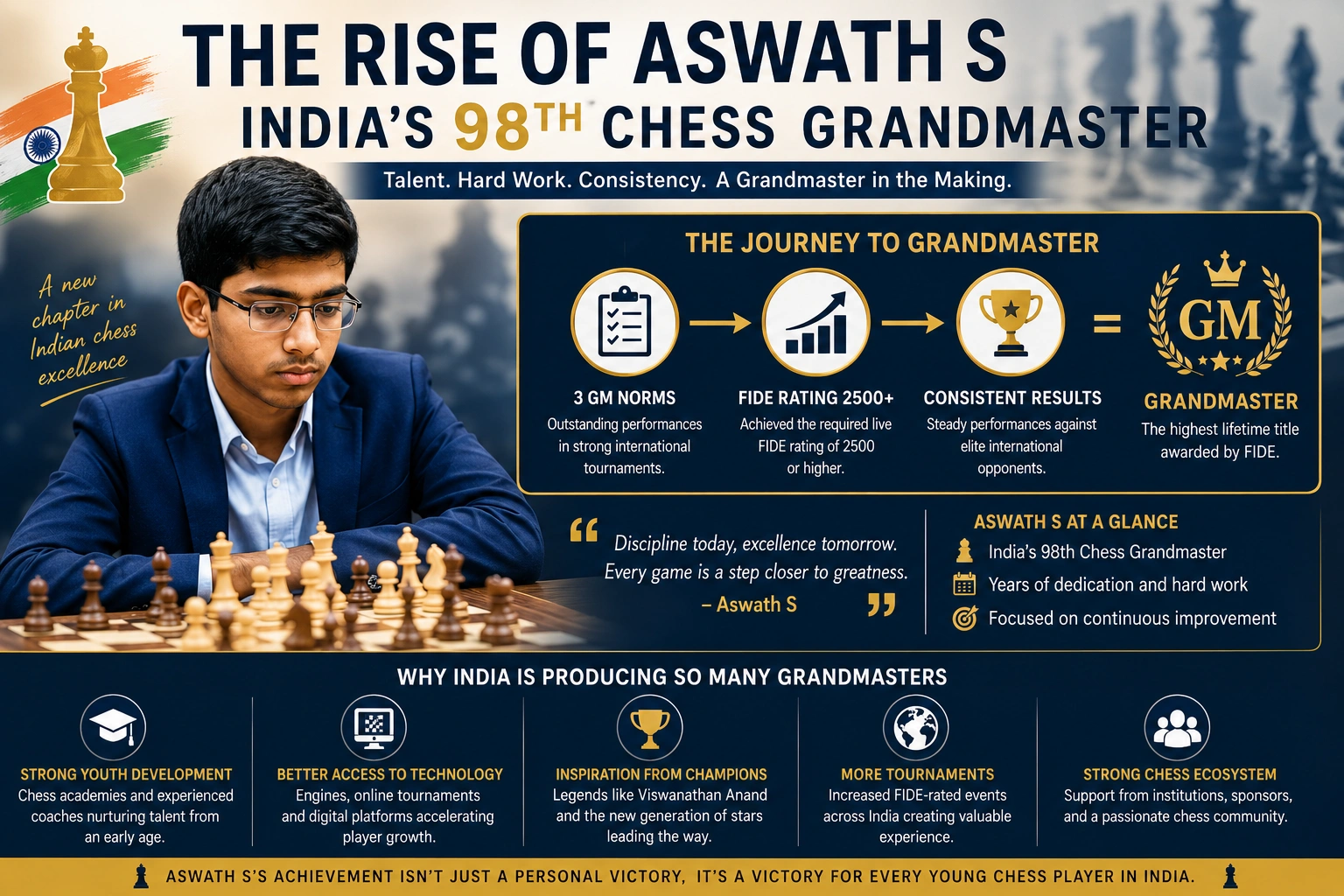
Several factors have contributed to this remarkable rise.
Strong Youth Development
Across India, chess academies now provide structured coaching from an early age. Young players regularly receive guidance from experienced trainers and former international masters.
Better Access to Technology
Modern chess engines, online tournaments, and digital coaching platforms have dramatically accelerated player development.
Inspiration from Champions
The success of Viswanathan Anand inspired an entire generation. More recently, players such as Gukesh D, R Praggnanandhaa, Arjun Erigaisi, and Vidit Gujrathi have shown that Indian players can consistently compete for the biggest international titles.
Increased Tournament Opportunities
India now hosts numerous FIDE-rated tournaments throughout the year, allowing young talents to gain valuable experience without extensive international travel.
India’s Remarkable Rise in World Chess
India’s chess journey has been extraordinary.
When Viswanathan Anand became India’s first Grandmaster in 1988, very few could have imagined the country would eventually produce nearly one hundred Grandmasters.
Today, India regularly competes for medals at the Chess Olympiad, produces world-class juniors, and has multiple players ranked among the global elite. The country has also become a preferred destination for major international tournaments, creating even more opportunities for emerging talent.
This sustained success isn’t the result of one exceptional generation. Instead, it reflects years of investment in coaching, competitive opportunities, and grassroots development.
What Comes Next for Aswath S?
Becoming a Grandmaster is a career milestone, but it is also the beginning of a new challenge.
Aswath will now aim to establish himself among stronger international competition by participating in elite open tournaments, closed invitation events, and team competitions. Future goals could include:
- Breaking into India’s top-ranked players
- Crossing the 2600+ rating mark
- Representing India at the Chess Olympiad
- Qualifying for elite international events
- Challenging for major continental and global titles
With India’s competitive chess environment becoming stronger every year, he will have plenty of opportunities to continue his development.
Key Takeaways
- Aswath S is officially India’s 98th Chess Grandmaster.
- The GM title requires three Grandmaster norms and a 2500 FIDE rating.
- India continues producing elite chess players at an impressive rate.
- Better coaching, technology, and tournament access have accelerated player development.
- Aswath now joins one of the world’s strongest communities of young Grandmasters.
Frequently Asked Questions
Who is India’s 98th Chess Grandmaster?
Aswath S became India’s 98th Chess Grandmaster after fulfilling all FIDE requirements, including Grandmaster norms and the required rating benchmark.
What is a Chess Grandmaster?
Grandmaster (GM) is the highest lifetime title awarded by FIDE. Players must achieve three GM norms and reach a FIDE rating of at least 2500 during their career.
Why is Aswath S’s achievement important?
His achievement reflects India’s continued emergence as one of the world’s strongest chess nations, with new elite players regularly reaching Grandmaster level.
How many Chess Grandmasters does India have now?
With Aswath S earning the title, India now has 98 official Chess Grandmasters, and the number is expected to continue growing in the coming years.
Conclusion
Aswath S’s achievement is more than an individual success—it represents another chapter in India’s remarkable chess story. Every new Grandmaster strengthens the country’s position as a global chess powerhouse and inspires thousands of young players dreaming of following the same path. If India’s current momentum continues, reaching the milestone of 100 Grandmasters may not be far away.