
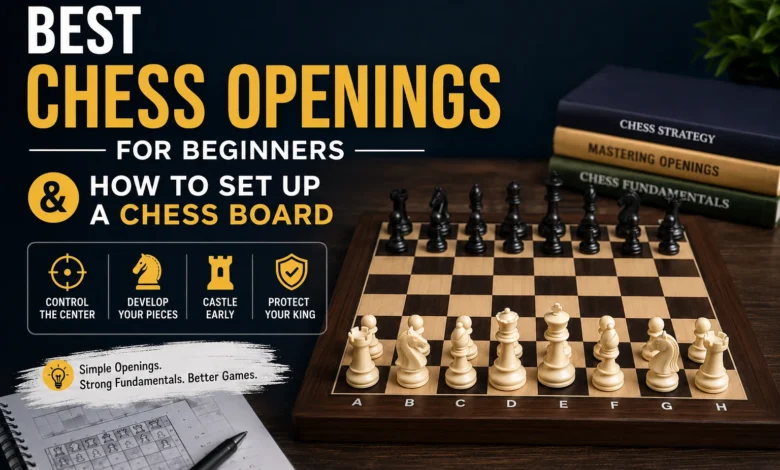
Imagine sitting down for your very first chess game. You know how each piece moves, but then comes the big question: What should I play first? Even before that, there’s another common mistake—many beginners accidentally set up the chessboard incorrectly. The good news is that both problems are easy to solve. Once you know the correct board setup and a few reliable openings, you’ll start every game with confidence instead of confusion.
Quick Summary: Chess Openings for Beginners
- Always place the board so the bottom-right square is white.
- Queens start on their own color: White queen on white, black queen on black.
- Control the center early with your pawns.
- Develop knights before bishops in most positions.
- Avoid moving the same piece repeatedly during the opening.
- Castle early to protect your king.
- Start with beginner-friendly openings instead of memorizing complex variations.
How to Chess Board Setup Correctly
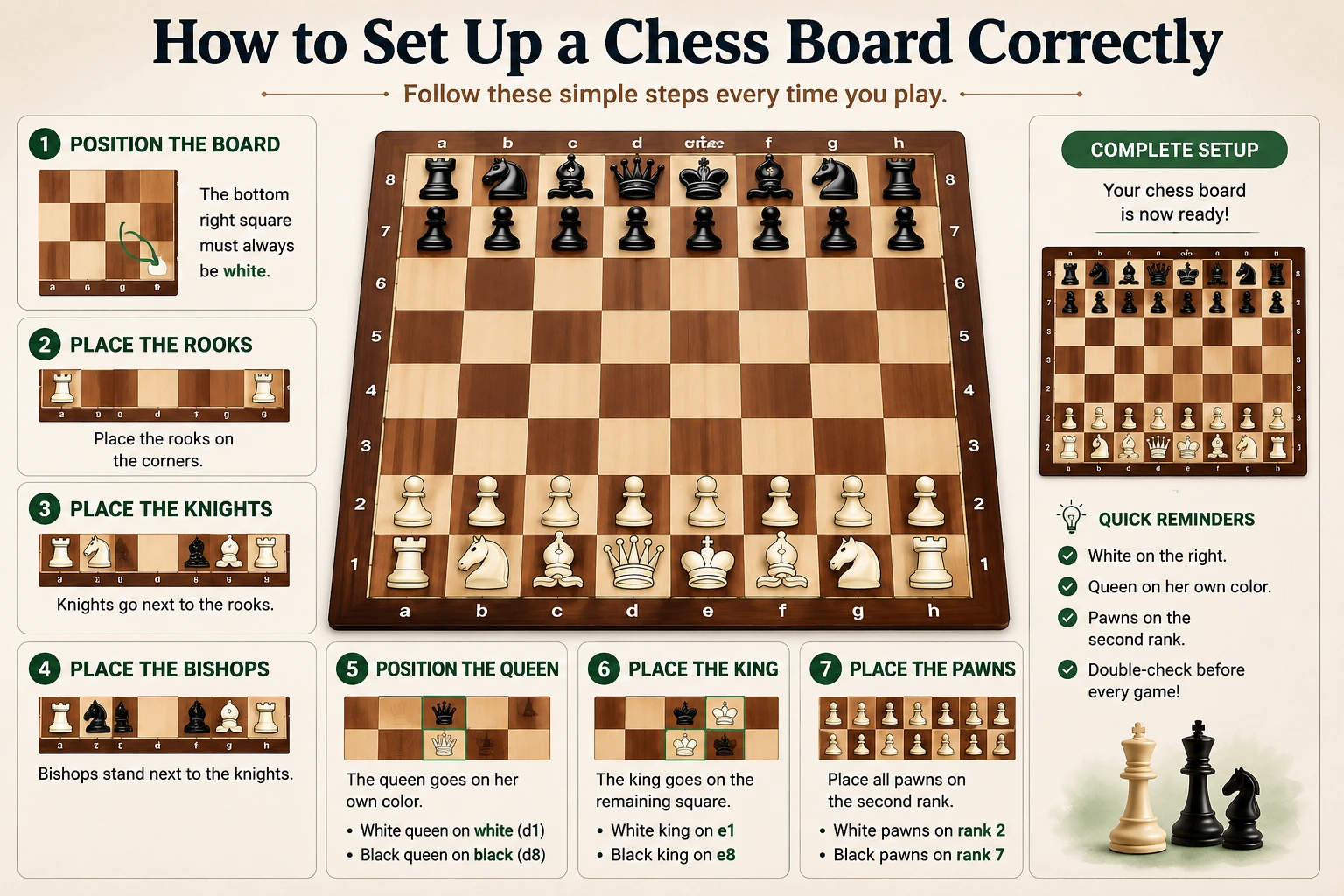
Before learning openings, you need to set up the board properly. Surprisingly, incorrect board setup is one of the most common beginner mistakes.
Step 1: Position the Board
The easiest rule to remember is:
“White on the right.”
The bottom-right corner square from each player’s perspective must always be a white square.
If this isn’t correct, rotate the board before placing any pieces.
Step 2: Place the Rooks
Each player places the two rooks in the corner squares.
White: a1 and h1
Black: a8 and h8
Step 3: Place the Knights
Knights go next to the rooks.
White:
- b1
- g1
Black:
- b8
- g8
Step 4: Place the Bishops
Bishops stand beside the knights.
White:
- c1
- f1
Black:
- c8
- f8
Step 5: Position the Queen
A simple memory trick:
Queen on her own color.
- White Queen → White square (d1)
- Black Queen → Black square (d8)
This is probably the easiest rule beginners remember.
Step 6: Place the King
The king occupies the only remaining square.
- White King → e1
- Black King → e8
Step 7: Place All Pawns
Each pawn fills the second rank.
White pawns:
a2 to h2
Black pawns:
a7 to h7
Why Does Correct Chess Board Setup Matter?
A wrongly placed board changes the diagonals, castling positions, and legal moves. If you learn openings on an incorrectly arranged board, you’ll quickly become confused when playing against others or using chess apps like Chess.com or Lichess.
Getting the setup right from the start builds good habits and makes every lesson easier to understand.
Best Chess Openings for Beginners
New players often believe they need to memorize dozens of opening moves. That’s not true.
Instead, learn openings that teach good chess fundamentals:
- Develop pieces naturally
- Fight for the center
- Keep your king safe
- Connect your rooks
Here are the best options.
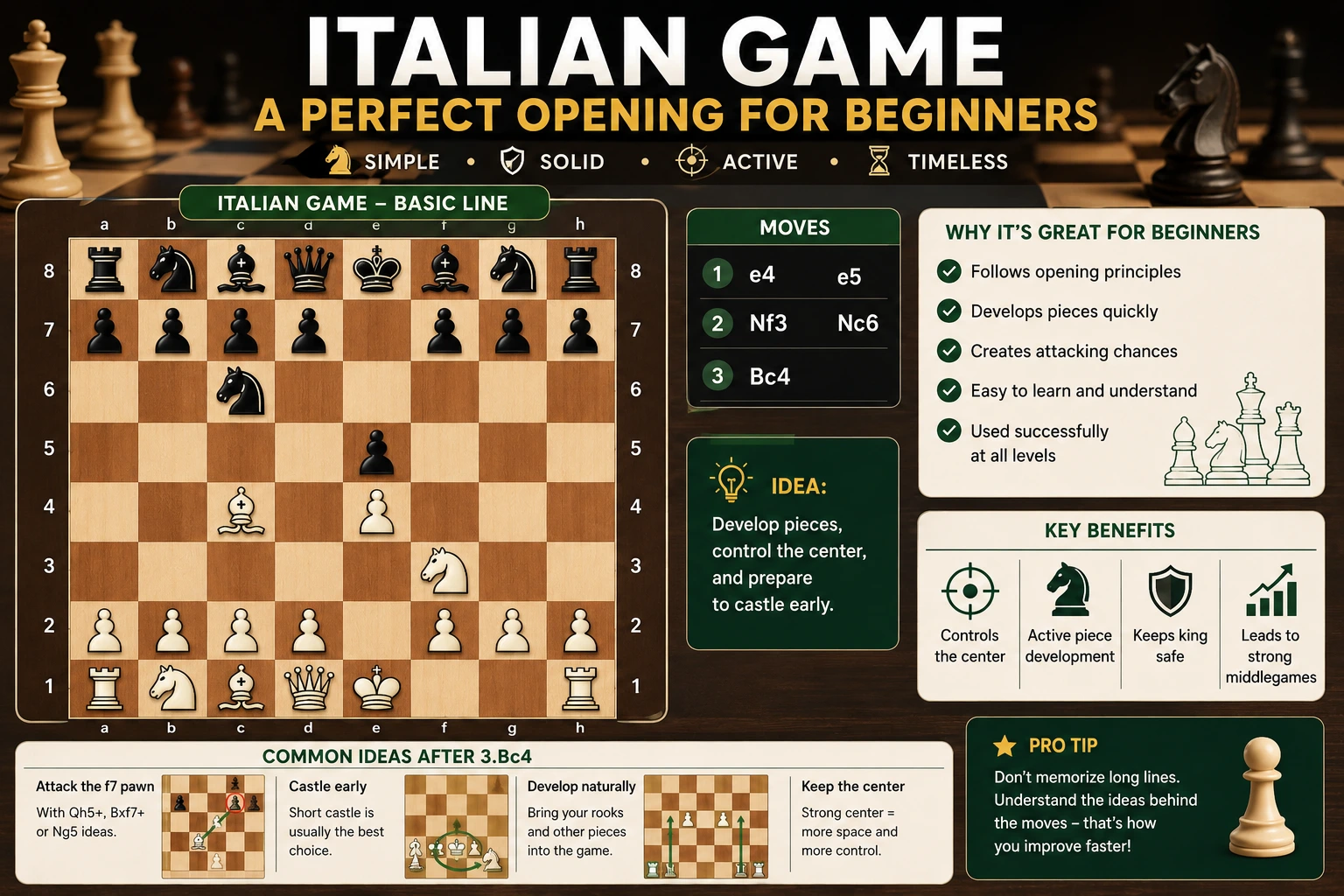
- Italian Game
Moves
- e4 e5
- Nf3 Nc6
- Bc4
The Italian Game has remained popular for centuries because it develops pieces quickly and creates straightforward attacking ideas.
Why beginners love it
- Easy to understand
- Fast development
- Early king safety
- Plenty of tactical opportunities
You’ll also see many famous grandmasters using this opening even today.
- London System
Moves
- d4
- Nf3
- Bf4
The London System is ideal if you don’t enjoy memorizing long opening variations.
Instead of reacting differently to every opponent’s move, you usually follow the same setup.
Benefits
- Consistent structure
- Low theory
- Strong defensive foundation
- Great for rapid and blitz games
Many club players rely on the London System for years.
- Queen’s Gambit
Moves
- d4 d5
- c4
Despite the word “gambit,” White usually isn’t sacrificing a pawn permanently.
Instead, White tries to gain central control while encouraging Black to make difficult decisions.
Why it’s beginner-friendly
- Teaches positional chess
- Strong center control
- Easy long-term plans
- Popular at every skill level
- Scotch Game
Moves
- e4 e5
- Nf3 Nc6
- d4
The Scotch Game immediately challenges Black’s center.
Unlike slower openings, it often creates open positions where piece activity becomes more important than memorization.
Beginners learn valuable attacking skills while avoiding overly complicated theory.
- King’s Indian Attack
Rather than memorizing countless opening lines, White develops pieces into flexible positions before deciding where to attack.
Typical setup:
- Nf3
- g3
- Bg2
- O-O
- d3
This opening emphasizes planning instead of memorization, making it ideal for newer players.
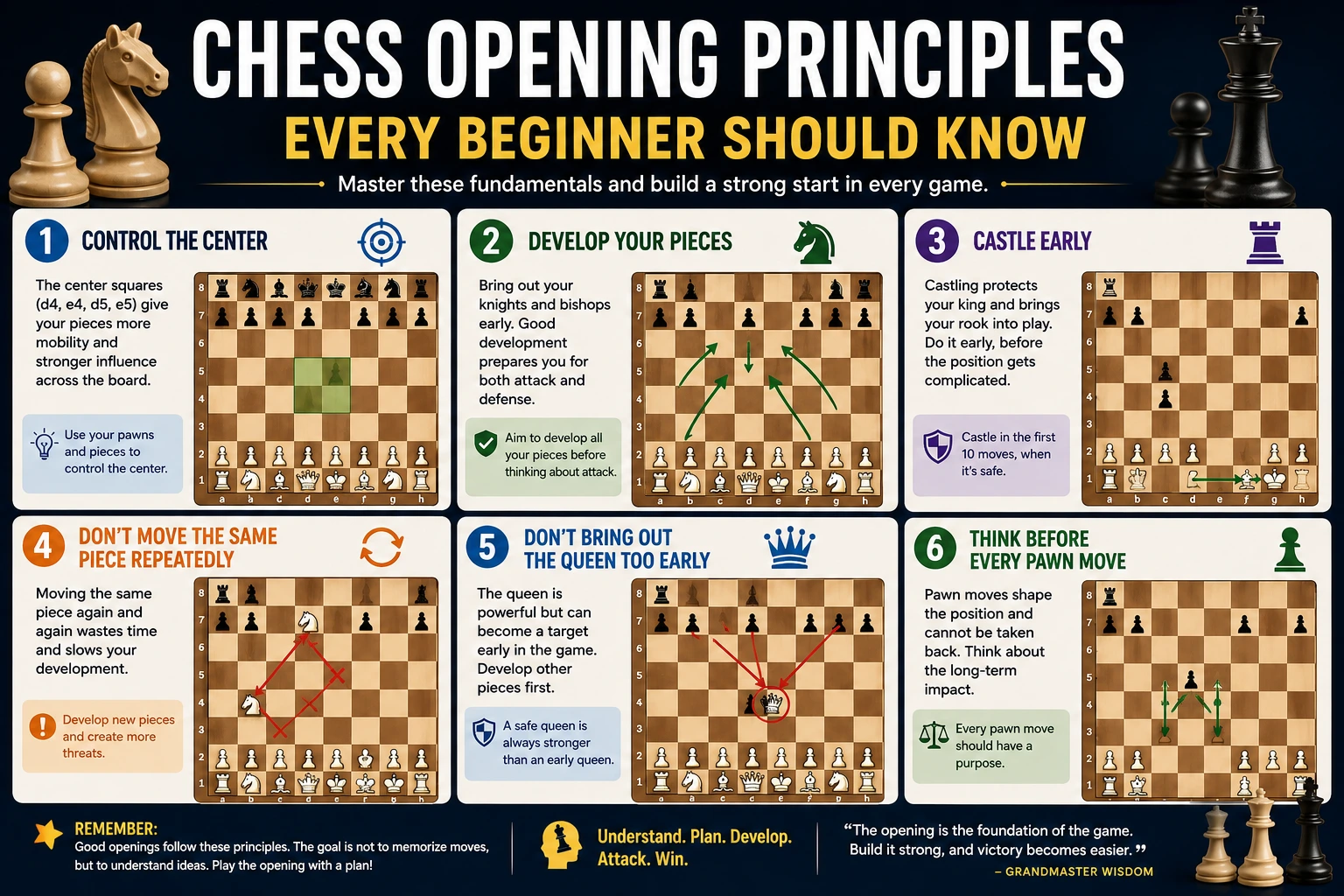
Opening Principles Every Beginner Should Learn
Knowing an opening is useful, but understanding why each move is played matters much more.
Control the Center
The four central squares—e4, d4, e5, and d5—are the heart of the board.
Pieces placed here can influence more squares and create stronger attacks.
Develop Minor Pieces Early
Knights and bishops should leave their starting squares quickly.
Avoid moving your queen too early because your opponent can gain time by attacking it repeatedly.
Castle Early
Castling protects your king and activates one rook.
Many beginners delay castling until it’s too late.
Whenever possible, castle within the first 10 moves.
Don’t Move One Piece Again and Again
Each extra move with the same piece means another piece remains undeveloped.
Unless there’s a tactical reason, continue bringing new pieces into play.
Think Before Every Pawn Move
Pawn moves cannot be undone.
Ask yourself:
- Does this help my pieces?
- Does it weaken my king?
- Does it fight for the center?
Strong players often spend more time considering pawn moves than beginners expect.
Common Opening Mistakes Beginners Make
Even after learning a few openings, many new players repeat the same errors.
Chasing Pieces Instead of Developing
Trying to attack one enemy piece repeatedly often wastes valuable time.
Focus on completing your development first.
Bringing Out the Queen Too Early
The queen is powerful but also a target.
If your opponent attacks your queen while developing their own pieces, you’ll quickly fall behind.
Ignoring King Safety
A beautiful attack means little if your own king is exposed.
Castling early prevents many avoidable losses.
Memorizing Moves Without Understanding Them
Instead of asking:
“What comes next?”
Ask:
“Why is this move played?”
Players who understand ideas improve much faster than players who simply memorize sequences.
Which Opening Should Beginners Learn First?
If you’re completely new to chess, start with one opening and play it consistently for several weeks.
A simple recommendation is:
| Playing White | Playing Black |
| Italian Game | Play …e5 against e4 |
| London System | Develop naturally against d4 |
Learning one opening well is far more valuable than trying to master ten different systems.
Frequently Asked Questions
What is the easiest chess opening for beginners?
The Italian Game is often considered the easiest because it follows fundamental opening principles, develops pieces naturally, and creates clear attacking opportunities without requiring extensive memorization.
How do you correctly set up a chess board?
Place the board so the bottom-right corner is a white square. Position the rooks in the corners, knights beside them, bishops next, queens on their own color, kings beside the queens, and pawns across the second rank.
Should beginners memorize chess openings?
Not extensively. It’s better to understand opening principles like center control, development, castling, and king safety rather than memorizing long variations that rarely appear in beginner games.
How many chess openings should beginners learn?
One or two openings for White and one simple response for Black are enough initially. Building strong fundamentals will improve results much more than studying dozens of opening systems.
Conclusion
Learning the best chess openings for beginners starts with understanding the basics—not memorizing hundreds of moves. Set up the board correctly every time, focus on controlling the center, develop your pieces efficiently, and castle early. Openings like the Italian Game, London System, Queen’s Gambit, and Scotch Game provide an excellent foundation while teaching principles that remain valuable even as you become a stronger player. Master these essentials first, and every game will begin with a clearer plan and greater confidence.
Also Read: List of Chess Grandmasters (Updated 2026)